«The purpose of education should not be to fill you with knowledge, but education should make you hungry for knowledge.»
— Debasish Mridha.
Hello there!
My name is Mariana, nice to meet you. I am a 21-year-old student whose plan is to become a teacher. What do I want to teach, you ask? Well, to be honest with you, I have always loved English. Ever since I was a little girl, I would ask my mom to play the movies in their original version and I would also ask my aunt (whose a native speaker) to speak to me in English. Therefore, when the moment came for me to chose a career path, I figured that I wanted to make others fall in love with this language as much as I felt in love with it too.
I am on my fourth and last year of university and I am about start my practicum, which is as exciting as it is nerve wracking, to be honest. I always get nervous when it comes to meeting a new class and a new teacher during my practicum. Mostly, because I feel like being a teacher is one of the most difficult jobs out there and it scares me not being able to reach the expectations. Nevertheless, I know that by working hard and learning as much as I can from those around me I will complete this practicum a lot more prepared and excited about what is about to come after graduation.
So, join me and I hope that by reading my experience you will be able to somehow live it with me, too. Talk to you soon.
As you all know, this has been an unusual year to say the least. Many unexpected thi ngs have happened that are out of our control and all we can do is wait, stay home, and do out part.
Unexpectedly, and sadly, our Practicum period was cut short back in March. Nevertheless, I am still very grateful for the time that I spent in the school, with the teachers I had de pleasure of meeting and having as mentors, and the kids I got to meet.
Like I mentioned on previous entries, I was very nervous at the beginning of February, but as soon as I got to meet the students and the teachers I would be working with, those nerves quickly became excitement.
I was supposed to spend a month and a half in the English department, working alongside the English teachers, and another month and a half with 6th grade. However, due to the lockdown, I was only able to complete the first half of the Practicum period, as I am sure every other university student did.
It was disappointing and sad suddenly saying goodbye to the school, the teachers, the children, and the rest of the university students who became my friends and whose company I truly enjoyed. Still, we know that it was for the best and I cherish every moment that I experienced.
From the very first week, I learned so much about being an English teacher. The teachers allowed me to be part of the lesson and it helped me to learn and grow more than I was expecting. I was able to experience first hand how teaching English as a Foreign Language is so much more about than just controlling the language, having a good pronunciation, and teaching a lesson.
Something that stood out to me from the very first week is how the English teachers were a hundredth percent invested in every single lesson and every single student. All the lessons were different and they would always include new multimodal resources and games, which is something that I really look up to. They would not just stick to the book activities, but they would propose many new activities and dynamics that the students enjoyed even more and made learning fun for them.
In other words, something that was truly undeniable to me is that they teach with affection. It seems ironic that I am writing about this exact topic in my TFG, but if something was made clearer to me after my Practicum experience is how important it is to build an affectionate teacher-student relationship in order to accomplish meaningful learning. The students look up to their teachers, behave well in the lessons, follow their instructions, and are excited to learn because they are motivated and like their teachers. I am more than happy that I was able to experience and be part of such a good learning environment, even if it wasn’t for long.
That is the reason why, for this entry, I chose that drawing at the top. It is a brain next to a heart. Both have flowers on them and it is actually pictured how the brain is being watered. As we all know, in order for flowers to bloom they need to be watered, looked after, and cared for. That is exactly how I imagine that kids learn, grow, and develop. As teachers, we have the power to help every single one of our students bloom healthy and beautiful flowers not only in their brains but also in their hearts; but we also have the power to drown some of those flowers. What kind of teacher will you be?
Just like Rita Pierson expressed in her TED talk back in 2013,
«Every child deserves a champion. An adult who would never give up on them, who understands the power of connection and insists that they become the best that they can possibly be. (…) It is not impossible. We are educators, we were worn to make a difference.»
That is exactly the kind of educator that I want to be. Someone who brings joy to her students with her teaching, who builds unbreakable bonds, who is able to lift her students’ self-steem and academic achievement at the same time, and someone who waters flowers not only in their brains, but also in their hearts.
Another aspect that I really enjoyed during my stay in this particular school is that I was able to see up close several multimodal lessons put into practice. A previous practicum student would go to the school three times a week to put into practice a whole didactic lesson plan that followed the multimodal approach with 6th B. I have got to say that she did an amazing job and that seeing her teach her activities, made me understand the way that a multimodal lesson works, as well as the amazing response from the students. She taught the children how to be good readers and she would prepare activities that encouraged students to be creative, as well as critical thinkers. It made me realized that there are much more ways to teach English than we imagine and that, if planned correctly, these lessons can challenge the students’ full potential.
Moreover, just as I have already shared with you, I also had to adapt my own multimodal lesson to teach the students from the distance. That is honestly something that I had never though that I would have to do any time soon. Still, it was a good way to practice; considering that, just like we have learnt, everything can change in a matter of hours. As future teachers, we need to be prepared to be there for our students and make sure they continue their education no matter the circumstances.
On another note, I am quite happy to write that I was able to continue my practicum period even after lockdown. I was contacted by the headteacher and given the opportunity to give online English lessons to the students via Skype from Monday to Thursday. I immediately sais yes, without thinking twice, since I knew it was a big opportunity and it pleases me to know that they trusted me enough to be part of the project.
I would be lying if I said that it has been easy and not time consuming. Preparing the lessons, the evaluations, keeping up with the schedules, the user names, starting one call after the next one, and focusing on my TFG at the same time. It has not been an easy task. Nonetheless, it has been amazing seeing how the students take it seriously, do their best, and keep improving with the vocabulary or structures that we have been working with. In a sense, I have had the amazing opportunity to continue with my Practicum Period and finish it; and I am very grateful for that.
I am happy to say that I have heard great feedback from the teachers and the parents of the children, too. The students think that this has been a great dynamic to practice English and that they enjoy speaking and learning this way as well, which was my main goal. I didn’t want the students to think of it as a chore, I wanted them to enjoy the lessons and look forward to the next one. Hopefully, I have achieved this goal with everyone.
All in all, the last three months have been quite exciting, as well as unpredictable, and stressful at times. Nonetheless, I am more than grateful for the experience that I have had with the school that I chose and with the teachers that I got to work with. Hopefully, in the future, I will have the opportunity to work as a full-time teacher in a school such as special as this particula one. I am looking forward what will come next.
In case you are currently reading this entry, but have not read the last one in which I explained my original lesson plan following the Multimodal approach, I advise you to go back and read the entry Designing and Planning a Multimodal Lesson before you continue reading this one. On that entry, I explained not only the practical aspect of the lesson but also the theoretical side to it .
If you have read it already, then you are on the right entry. Today, I will share with you how I modified the original lesson in order to make it fit to the level of the students that completed it (considering that I ended up applying the lesson to younger students), but without changing the main objectives and ideas that I had originally set.
As you know, I designed a lesson around the picture book The Lion Who Wanted to Love; following the multiliteracies pedagogy approach that is comprised of four knowledge processes, which are the following: experiencing, conceptualizing, analyzing and applying. For this modified lesson plan, I tried to keep as intact as possible the processes to follow the same purpose and achieve the sam objectives.
Therefore, I decided to cut the follow-along lesson short and modify it in order to make it easier for the students to keep their focus and be able to complete the activities; instead of sending them the whole video, I sent them written activities, as well as the storytelling part of the video.
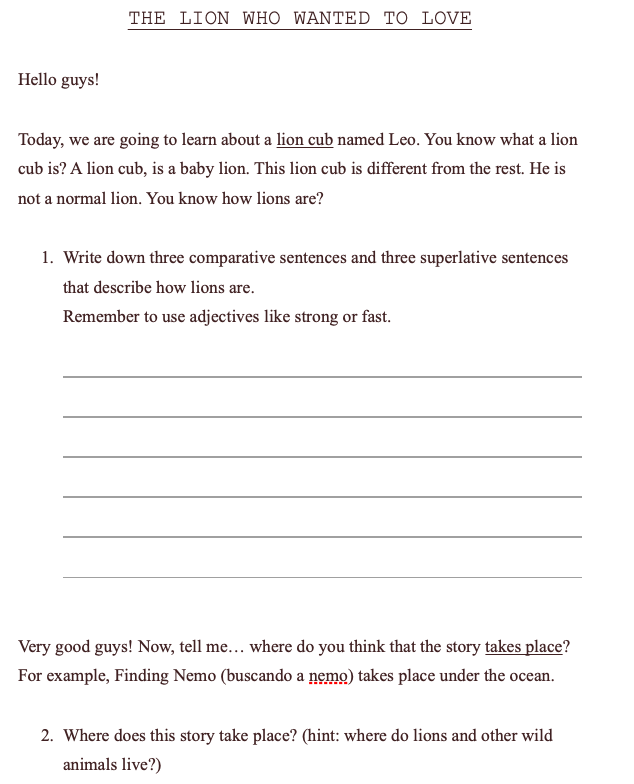
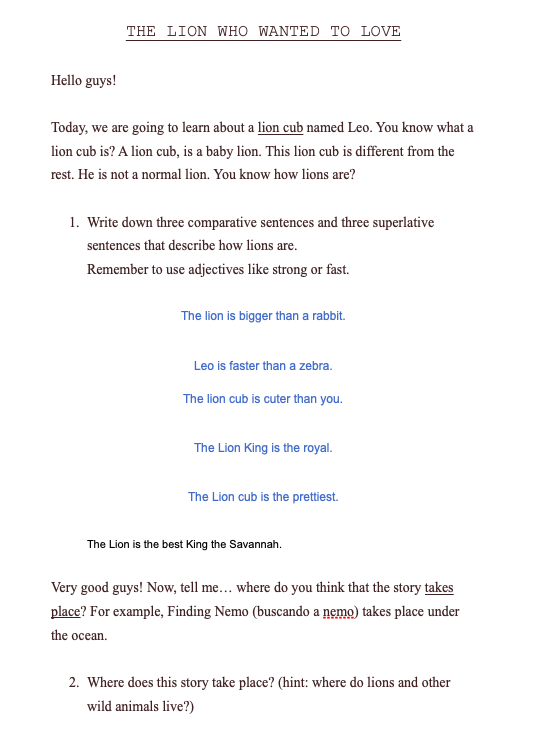
As you can see, for the experiencing process, I wrote down the introduction for the learners to get into the story and asked them to write down 3 comparative and 3 superlative sentences to describe lions. In fifth grade the students were working with these kinds of sentences when I was with them and even completed an activity with wild animals in which they learned adjectives such as fast, fierce, strong… for this reason, I saw fitted to add an activity following the same dynamic.
Moreover, I asked the students to write down where they think the story might take place and added a hint, as well as an example.
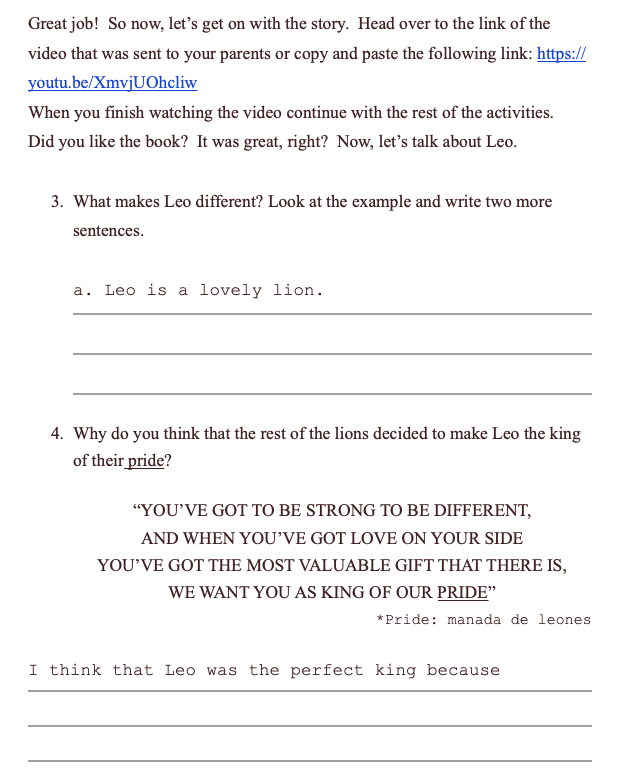
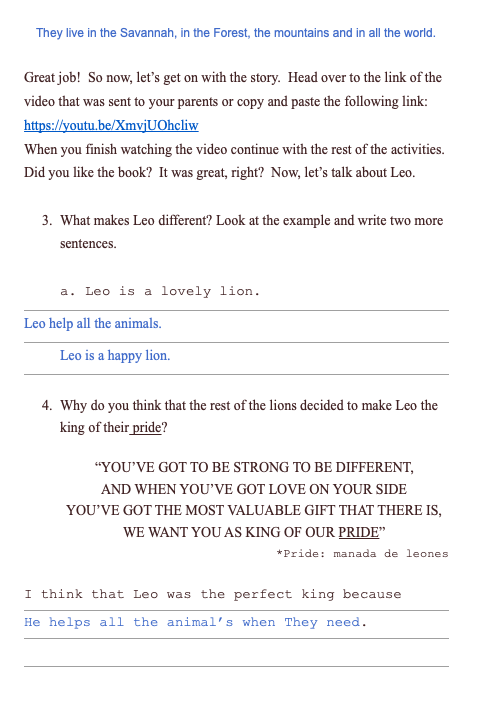
For the conceptualizing process, I indicated the students to copy the link written down, watch the storytelling video, and continue with the following activities afterwards.
Then, to continue with the analyzing process, I asked them some questions about the picture book to reinforce the story and the main idea displayed on it. I included the last dialogue, which holds the main idea and moral of the picture book for them to reflect on it.
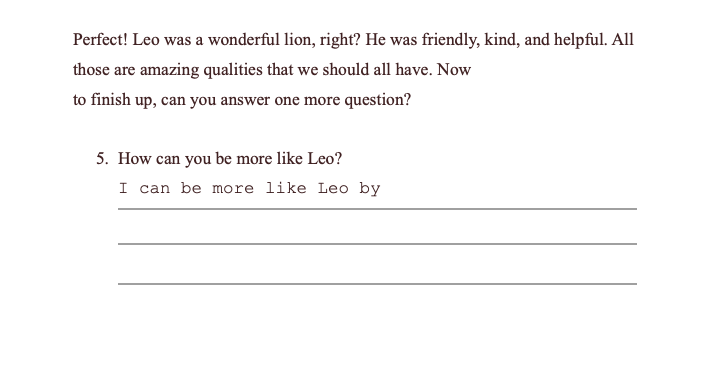
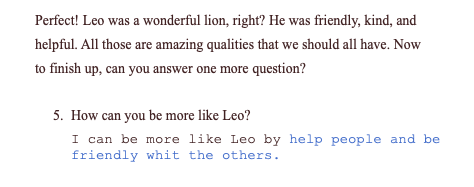
Lastly came the applying process. I, once again, shortened this section and asked the students a single question: «How can you be more like Leo?»
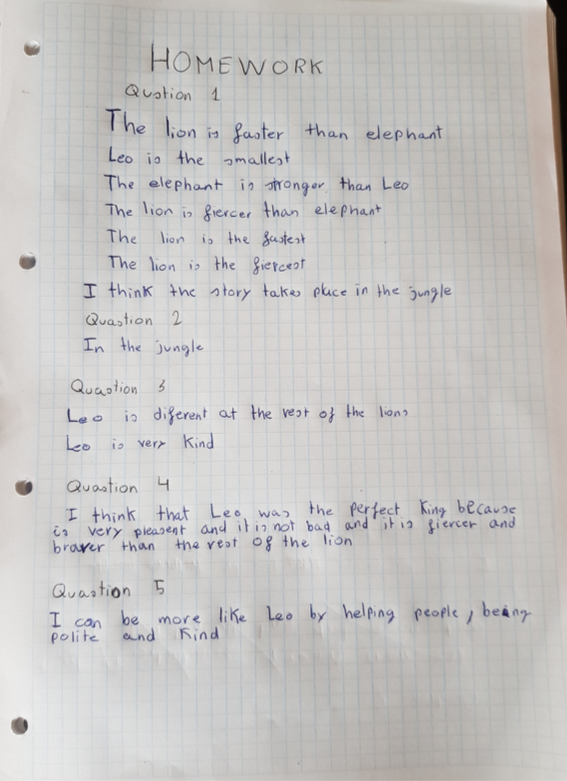
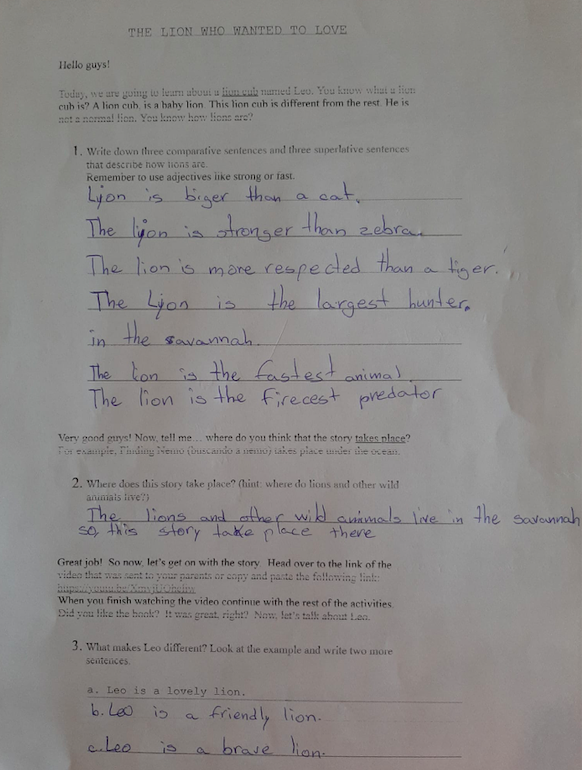
Since I could not teach this lesson to 6th grade, I cannot examine and reflect on Noah’s and Mateo’s work. All the same, I wanted to share with you some of the answers that caught my attention the most and that showed me that the students were able to understand the story and activities.
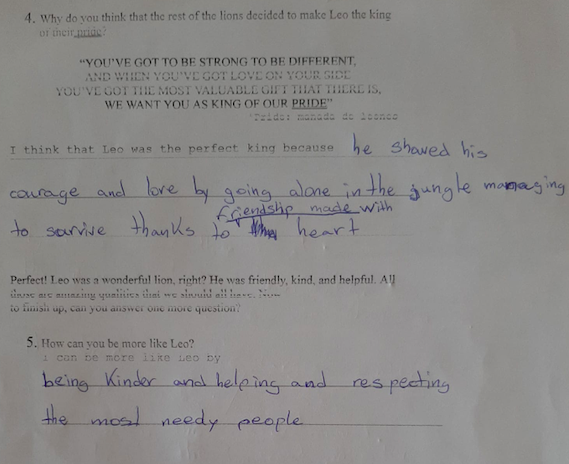
Student 1 Student 2 Student 3
As I expected, in the first exercise the students used the adjectives fierce, fast and strong to describe lions. Nevertheless, some students also created sentences using adjectives such as cute, royal and pretty to describe lion cubs and Leo; as well as respected or large to describe lions as hunters, which really stood out to me.
Another detail that I wanted to highlight was how every student was able to recognize and understand that Leo was a helpful and kind lion who wanted to be there for the other animals. I especially like how in the fourth question, the first student describes Leo as pleasant and «not bad», which makes him braver and fiercer than the rest of the lions and consequently, the perfect king; moreover, the third student considers that Leo was the perfect king because he showed courage when he was kicked out of his pride and was able to survive with the friendships he made.
Lastly, on the last question, it seems like all the students believe that in order to be more like Leo it is necessary to help others more and be kinder, which is one of the answers that I was looking for.
I am very happy that even if it wasn’t as I had originally planned, it was still possible for me to send out the lesson for the children to complete and work with from their homes and get back the results.
Of course, it was impossible for me to help the students get to where I wanted them to be in the story and to ask them deeper questions to make them think more critically. Still, it seems like the students were able to understand the story and the questions that I asked them which was ideal and necessary for the lesson to work.
I hope that you enjoyed this entry! Feel free to leave me any comment and feedback, I appreciate them all.
I hope you are all staying safe at home during these circumstances that we are currently living.
For this entry I will be sharing with you the original Multimodal lesson that I had planned for the students to complete in the classroom; even though that, for obvious circumstances, I will not be able to teach it.
I had planned it initially for sixth grade before the schools closed, so in this entry I will be sharing with you the model and way I was planning to teach it in the classroom. Keep in mind that now the lesson is meant to be for fifth grade, so I had to make some adjustments to make it easier for the students. Once again, in this entry I will be explaining the original multimodal lesson and then, I will write another entry in which I will explain the modified one with the feedback and results that I get back from the students.
First, let’s dive a little bit into the importance of multimodality, considering that it takes a huge role in lesson planning nowadays due to the society that we currently live in and the mindset that rules it. We live in a constant rush to be somewhere, to keep moving… We are constantly receiving new information from different sources and focusing on so many things and details at the same time. This affects children as much as it affects adults and, as a result, the educational demands have shifted as well; which has resulted in the implementation of multimodal resources in the classroom that engages learners in the lessons in a whole different way than standard methods and approaches. Therefore, for this lesson plan, I followed the multiliteracies pedagogy approach that is comprised of four knowledge processes: experiencing, conceptualizing, analyzing and applying.
For this lesson (as well as for the modified one that I am going to send to fifth grade), I decided to plan it around a picture book called The Lion who Wanted to Love by Giles Andreae. There are many reasons why I chose a picture book as a multimodal text to based the lesson around. First of all, children love stories. They usually show great excitement to listen to new stories and, for this reason, they want to make sense of the story and the meaning, which is easier for them when looking at the illustrations and images that go with the text. Another reason is that stories help children relate new things to what they already know and it is useful to help them develop new thinking skills. Let’s also not forget that telling the story of a picture book to students involve role-play, which scaffolds their learning and understanding of what is happening in the book.
Now, why did I choose this particular picture book, though? Giles Andreae is one of the UK’s most famous and popular pictures book authors with many bestselling and award-winning titles to his name. His stories often teach about self-steam, negative stereotypes, and love (among other great and important values), all of which are important topics to discuss and work with our students. And what better way to do so than through English?
This particular picture book that I chose tells the story about a lion cub who is different from any other lion. Instead of feeling the need to hunt, be fierce, and feel strong, Leo wants to make friends and love everybody. He’s different and, even though at first he is not accepted by everyone and is expected to act like what is considered a normal lion, he sticks to his personality and decides to spread love.
Another detail that caught my attention was that the author was inspired to write the book from a poem that he wrote himself a couple years ago but then put aside. The poem is the following:
After writing said poem, Giles Andreae continued to write lots of other poems and stories, but he could not shake away the lion cub who was out of the ordinary, and so finally, one day he decided to sit down and write his story. This little detail really meant something to me due to the current society that we live in, where fitting in and living up to the expectations set by others can often rule our lives.
In order to be able to give you an idea on how the three sessions were going to work and the activities that I had originally planned, I decided to film a follow-along lesson. My idea was to send this video to the students so they could complete the exact same activities at the same time that they were visualizing the video. Nevertheless, after sharing the video with the headteacher and since I couldn’t teach it to sixth grade, we came to the conclusion that it was better for me to send only the storytelling part to fifth grade and make some changes in the lesson, but that is for another entry.
In the original video, I filmed the way I would introduce the picture book, me telling them the story, showing the book, telling them when to complete all the activities, and giving every necessary instruction. As expected, the video turned out to be a bit long, but it is still the same length as a regular session and with the added time of completing the activities, it would have taken around three forty-minute sessions to complete.
Just like I mentioned before, when choosing the activities I followed the Multimodal approach. This meant that I had to make sure that the students were going to be able to develop some kind of emotional connection to the topic that I selected, which was possible through the implementation of four processes of the multiliteracies pedagogy approach proposed by Kalantzis et al (2016): experiencing, conceptualizing, analyzing and applying.
For the experiencing process, I had planned pre-reading exercises and activities, which would have led students to get in context with the story, understand the main idea as well as the topic that we were going to discuss in the session, and to start engaging them meaningfully. Therefore, I was going to start the lesson by telling them that I was going to read them a story about a lion cub. Then, I was going to ask them to write down where they thought that the story was going to take place (the jungle). Afterwards, I would have asked them a bit about lions, since the main idea of the story is to understand that Leo is different to regular lions:
"How would you describe a lion?" "Are lions friendly, cool, or...?"
The activity was to tell them to write down 3 to 5 adjectives that can be used describe lions. To continue with the experiencing process, The students had to write down what the title of the book suggested to them and what they thought the book would be about. It is also worth mentioning that there is a lot of new vocabulary in the book that I was going to introduced in this part of the lesson, so they would have familiarized with it before listening to the story.
From here on, I moved to the conceptualizing process through the reading part of the lesson and storytelling. I was nervous about this part, considering that during the lesson I would have had to make sure that they were going to make sense of the story and, consequently, produce meaning. Therefore, I would have tried to emphasize the words as much as I could and thought necessary to make it easier for the students to catch everything.
Next came the analyzing process, in which I was planning on presenting a series of questions to get the students to reflect on the author’s writing and relate it to their own experiences and perspective. But first, to work on the new vocabulary, I was going to present to the students a list of new words that I wanted them to remember and learn the meaning of. They could have written them down, looked for the meaning, and finally made a little drawing beside the word that would have helped them remember the definition. This is an activity that my primary teacher would make me do every single time we read a book and found new words; I can honestly tell you that, to this day, I still remember some of the words and drawings I had on my notebook. Moving on with the analyzing process, the questions that I would have urged the students to reflect on where going to be the following:
"What makes Leo different?" "How do you think that Leo felt when his mom sent him away?" "Have you ever felt left-out and different, just like Leo did?" "Write about how Leo's mom changes her attitude towards Leo from the beginning to the end of the story." "And the ending? What do you think that the following lines mean? YOU HAVE GOT TO BE STRONG TO BE DIFFERENT, AND WHEN YOU’VE GOT LOVE ON YOUR SIDE YOU’VE GOT THE MOST VALUABLE GIFT THAT THERE IS, WE WANT YOU AS KING OF OUR PRIDE."
Lastly, finishing up with the applying process, I had come up with three final activities that would have allowed the students to elaborate their own interpretations and carried out new practices in new contexts. For the first one, learners were going to be given the following quote:
«Love conquers all»
The main idea was that students had to draw what came to their mind when they thought of this quote. It could be anything from a quality that they notice on their parents, something nice that someone once did for them… anything that love and its power might suggest them and evoque from them.
For the second activity, students would have drawn once again and described with short sentences a moment or circumstance in which they felt like Leo at the beginning of the story and struggled to meet expectations or felt different from the rest.
And last but not least, in order to wrap up the session and to practice speaking, I would have asked the students to tell me how they could be more like Leo: loving and helpful to those who surround them.
I am not going to lie, it was a little bit hard planning the lesson and making sure that everything was explained correctly and clearly. It also saddens me that I am not going to be able to teach; I was looking forward to it.
I am sure that you will notice certain things that I could have done differently to improve the lesson, too. Nevertheless, I am proud of it and I was hoping for amazing results once the students got to do it. Here is the link to the video that I filmed for you to visualize better the way the lesson was going to work, in case you want to check it out: https://youtu.be/QjSCW8a-Znk
I am happy to be writing this entry today. I have been truly enjoying this practicum period and I am very excited to be able to share my experiences with all of you; as well as reading your own experiences and thoughts through your blog entries.
I know that we are all on the same boat right now and that we are finding ourselves with some free time on our hands. Hence why I wanted to share some exciting things that I have been experiencing these past two weeks.
Just like I have shared with you on different occasions, I am very happy with the teachers that I have been with this past month. She is truly a great teacher, who uses different multimodal resources to teach her classes and does not follow rigidly the traditional methods. I know that I can offer activities and participate in the lessons freely when I am with her in fifth and sixth grade. What I am really excited about is that she trusts me to do so, too.
Last week, she told me that I could feel free to choose a day to be in charge of the whole lesson, bringing my own activities and designing the session on my own. I chose to practice with sixth grade since they are the class that I will be in the following months. So I planned a lesson in which they could practice the Past Tense and the Wh questions because that had an exam about that on the following week.
I had to design a 45 minutes lesson, so I knew that there were limited activities that I could and would be able to complete. Nevertheless, I planned more activities than I knew would fit in the session so that I would not be empty-handed. I wanted to come up with activities that allowed the students practice their writing, challenge them to experiment with the language, and have fun while doing so.
As a first activity, I wrote an email. This email contained some vocabulary that I knew they would ask about, as well as simple and easy-to-understand vocabulary. The reason behind this is that I wanted to keep it in their level, but also challenge them to come up with the definitions and meaning of some expressions and words on their own, with the help of the context and explanations in English given by me in order to scaffold them. The email was addressed to a «friend» of mine, who I wanted to share with my adventures in Australia during a previous trip. Most verbs were written in the present tense and there were some other mistakes that the students had to find on their own. The main objective was for the children to change the verbs written in the present tenses to the past tense and to identify some mistakes that I had included in which the verbs after did were written in the past form intead of the present form.
For the second activity, the students had to work in groups in a contest. Using the previous email, I gave them some sentences that worked as answers to Wh questions that they had to write and come up with on their own in teams. When they had formulated their questions, a person from each team had to go to the board and write their team’s question. Afterwards, the whole classroom would read each question from each team and we would find the winning team, adding them points.
Lastly, for the last activity, they had to work as a whole team. So instead of small groups, the whole class had to participate equally on writing their own email using the past tense and Wh questions. They all had to cooperate and give sentences that matched the sentence given by the previous classmate and I could help them link them. Sadly, we did not have enough time to work on this activity. Nevertheless, my teacher asked me to scan the activities to keep them and work with them some other day, since she enjoyed the lesson as well.
Note: Even though here the activity is written, I would have explained it orally.
I thoroughly enjoyed being able to be in control of the lesson and I think that the students enjoyed the activities as well. I am looking forward to planning and giving the multimodal lesson in the near future, too.
Now I want to hear from you. What do you think about these activities? Would you have done them differently?
«Successful and unsuccessful people do not vary greatly in their abilities. They vary in their desires to reach their potential.» – John Maxwell
Hello again everyone!
Welcome back to my blog and this week’s entry. Hope you all had an amazing week.
Today, in order to continue with my child study project I will be focusing on analyzing the student’s English notebooks.
Through a notebook, you can get to learn more than you would initially imagine about a student. You can tell a lot about a child when seeing the way they write, the way they decorate their front page, the way they keep their notebooks organized (or not, for that matter), etc. It really shows their personality as students. Hence, that is what I will be looking into today.
Let us begin, shall we?
One of the first things that catches my attention is that Noah has a front cover that indicates that his notebook is for English; whilst Mateo did not think that it was necessary to draw one since it was self-explanatory. If you ask me, even if it is not a big deal and does not affect them in any way having or not having a front cover, it comes to show how different they are when it comes to academics. Noah, one the one hand, drew the cover without having to be asked to; Mateo, on the other hand, was not bothered by not having a cover and decided to skip it.
While we are at it with some differences that I found in both notebooks, I have got to say that Noah tends to keep his notebook rather neat and formal-looking. He does not make drawings or doodles in his work; Mateo, though, tends to doodle a bit more, which shows his sillier personality.
MATEO’S NOTEBOOK
MATEO’S NOTEBOOK
NOAH’S NOTEBOOK
It is also worth mentioning that, when paying special attention to their activities and corrections, none of them make the kind of errors that are alarming. Noah makes small mistakes in dictations that can easily be corrected, showcasing a good control over the language; he sometimes misspells words, for example, he writes ‘difficult’ with one f instead of two. Contrarily, Mateo tends to make more numerous mistakes and, therefore, showcases a lower control over the language; he confuses some words like ‘his’ with ‘he’s’, sometimes writes ‘me’ instead of ‘I’, misspells some words like, for example, writes ‘butterflies’ with a y instead of the i, and forgets to ad the ‘a’ infront do singular nouns.
In addition, I was also able to see that they make some false friends and sometimes tend to confuse English with Valencian. For example, both Mateo and Noah wrote ‘redaction’ instead of ‘composition’ on more than one occasion, thinking of the words ‘redacción’. In this case, it was actually Noah the one who did not correct his mistake multiple times and had to be helped by the teacher. Mateo, contrarily, made the mistake and corrected it himself. Nevertheless, he also used some Valencian and Spanish words in his notebook, for example, ‘unitat’ instead of ‘unit’, ‘harina’ instead of ‘flour’ and azucar instead of ‘sugar’; in addition, he tends to make more mistakes when it comes to writing producing his own text.
As seen underneath, Noah is very much capable of expressing his ideas in English and tends to use small sentences to do so. Elseways, I would not say that Mateo is not able to express himself in English, nevertheless, he does make some more major mistakes; for example, as seen underneath as well, instead of writing ‘My turtle is 11 years old’, he wrote ‘My turtle have 11 years’. Once again, this portrays how he translates what he is thinking literally from the Spanish way of saying it. Moreover, he does not separate the sentences for the most part, so it is a lot more difficult to understand what he is trying express.
MATEO’S NOTEBOOK
NOAH’S NOTEBOOK
MATEO’S NOTEBOOK
MATEO’S NOTEBOOK
All of these different aspects that I have been discussing in today’s entry are mistakes that Mateo and Noah can most likely grow out off if they practice and are made aware of their mistakes.
Multimodal classes are a great way to experiment with the language and gain motivation to learn and get better at it. A great way to work with some of their spelling mistakes is by preparing reading activities and teaching English through literature. This would require for them to pay full attention to what they are reading, not only to makes sense of the story but to focus as well on the way it is written, the vocabulary, and the spelling. Addiotionally, they would learn new vocabulary and would improve the way they express themselves.
Hopefully you have enjoyed this entry. Feel free to ask any question or the leave any comment, as well as feefback.
First of all, welcome back! Thank you for once again taking the time to read my blog.
In this entry I will be starting a child study, which starts with selecting two students to work with and describing some important aspects about them. Keep in mind that the students real identities need to be kept private and, therefore, I will be using different names instead of their real names; nonetheless, you will get to learn a bit about two students from the school that I am currently attending.
I have got to say that both students are remarkable in their own way. Each have their own qualities as well as weaknesses. The reason why I chose these two students is because they both stood out the moment I met them, for different reasons. They are quite different to be honest, which makes me even more excited to be doing this.
Let’s start with Noah, shall we?
Noah is twelve years old. He has been studying for a long time in the school and was described as kind, hard worker, driven, and greatly interested in learning new things and acquiring new skills.
The first thing that is noticeable about this particular student is that he truly stands out in each and every subject. He is not only a smart student, but he is also motivated to learn and responsible. One of his favorite subject is mathematics, although he likes most subjects.
When it comes to his social relationships in the classroom, Noah is always polite but a bit shy, too; nevertheless, very well integrated with his peers. Something worth mentioning is that he is is friendly and accepting of everyone. He never gets in trouble and he is friends with everyone.
Referring to his literacy and language skills, Noah has a good control over the use of the language and knows how to use both the formal and informal discourses. He is also good in English and knows how to express himself very well.
He comes from a high social-cultural and economic level. Both his parents attended university and Noah was raised by both of them equally.
The second student that I am going to introduce to you today is Mateo.
Mateo is a bit different from Noah. He is also very friendly and can be very shy sometimes. Nevertheless, he is very outgoing, which can sometimes result in Mateo being impulsive and mocking. To put it in simple words, He is the class clown. He always has something funny to say and loves making his peers laugh.
When it comes to personal interests, Mateo is not a big fan of school. He shows rather disinterest in studying and excelling in academics, do not get it wrong thought, he can be lazy but he is also very intelligent. He can be very organized and loves to keep his notebooks clean. His hobbies include playing video games and football. Even thought he is good friends with everyone, he can also get in misunderstandings and disagreements with his classmates every once in a while.
When it comes to his language and literacy skills, Mateo has a good use of the language, too. He tends to be polite when he needs to be and expresses himself well.
Referring to his family situation, Mateo comes from a more complicated background. Both his parents are foreigners but he was born in Spain. They have not been together since he was a baby so he does not have memories with both his parents. He lives with his father and his grandparents and his mother does not live in Valencia.
In case you are wondering why I chose these two students to work with, the answer is quite simple, honestly. One the one hand, Noah is a grade-A student. He seems to excel at everything he does which makes me curious about the way he processes information and the way he works. One the other hand, Mateo projects himself as a disinterested student, who does not care much about anything related to school. Although, if you ask me, he happens to have a complex and quite intelligent mind worth trying to understand.
Hopefully you have enjoyed reading this entry. Talk to you soon.
I had not imagined that I would enjoy this first week in the school as much as I did. Not because I do not enjoy the practicum, or because I was not sure about the school that I have chosen; but because I thought that the nerves and anxiety would overshadow how truly fun and exciting is to get to meet a new class and a new teacher staff.
On Monday, the head teacher showed us around, read us the rules and informed us that each of us had already being assigned a class, so we could not chose the grade. At first, I was a little bit sad; mainly, because I was hoping I could be with first or second grade since I have never been with the smaller children. Nevertheless, I was not disappointed with their decision.
The group that I have been assigned to is sixth grade. Usually, people prefer to be with the younger children due to the fact that fifth and sixth grade are considered to be pre-teens, as well as a bit more «forward». Nonetheless, I have never thought that it was harder with older kids and was really excited to get to know them. As it is right now though, I am full-time in the English lessons with all the grades, which I love even more.
The English lessons in this particular school are given by two different teachers, one of whom is taking some time off work at the moment. Therefore, throughout the week I got to meet the substitute teacher, who will be teaching English to the younger grades, as well as the school’s principal, who happens to teach this subject to the older grades.
This week it was an observation week, which means that I mainly took notes and viewed how the classes are taught in order to learn the dynamics of each class, the way the lessons are programmed, and the language level of the students. I am truly happy with the way both teachers work and with the way they both received me in their classroom; I am really looking forward to getting to learn more from them.
I was also very pleased and surprised with the student’s English level and with their performance in the class. They generally participate and tend to show interest in the learning of the language, which is not always as common as it should be. They are all round good and respectful students.
I could not be happier with the choice I made when I decided to complete my practicum in this particular school and I am so excited for the next few months that are coming my way.